Plan an ESS investigation around a local environmental issue
Connect a measurable local question with a relevant strategy, perspectives and a feasible collection method.
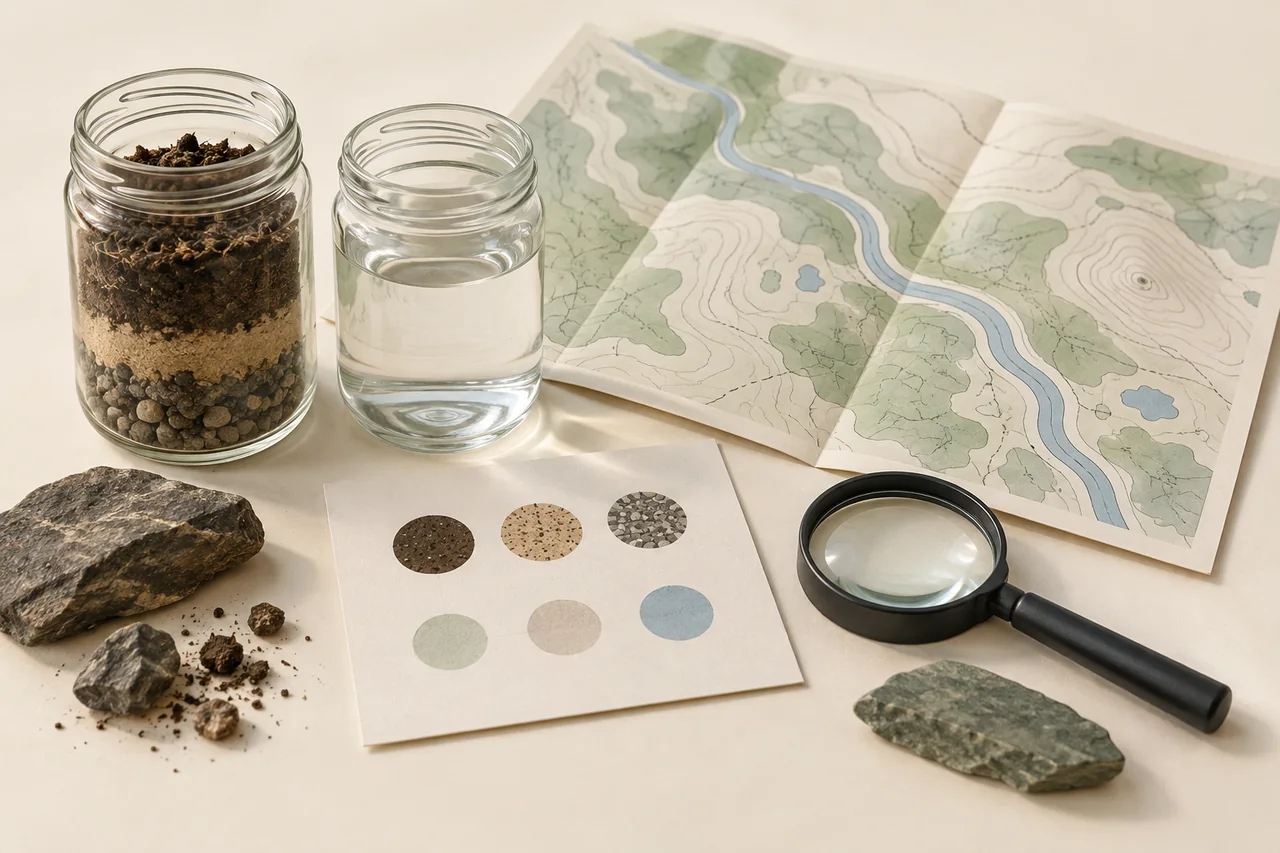
Identify the environmental issue and measurable question
Choose a local issue you can investigate with accessible evidence. Define the site, period and response before selecting a method. An illustrative question might compare the proportion of incorrectly sorted items at permitted school recycling stations under different signage conditions. Specify what counts as an item and how sorting will be classified.
The example requires school permission and a suitable observation method. Do not handle waste or collect identifiable information without arrangements approved by the school. Discuss what evidence can address the question within the available time.
Keep the system and strategy connected
ESS combines environmental systems with societal perspectives. In the course first assessed in 2026, the investigation includes attention to perspectives affecting a strategy related to the issue. Identify a relevant strategy early and discuss its role with your teacher so it is supported by evidence, rather than appended to the report.
For recycling signage, the strategy could aim to improve sorting. Students, facilities staff and administrators may value convenience, reliable classification, cost and waste reduction differently. Investigate those perspectives appropriately instead of assuming what each group thinks.
Design a comparable observation
Define the sampling unit, observation period, location and classification rules. A proportion of incorrectly sorted items requires both a numerator and a meaningful denominator. Compare similar contexts where possible, such as equivalent periods and stations with comparable use. Record conditions that could influence the result.
If signage conditions differ alongside station location and traffic, you cannot readily attribute a difference to signage alone. You might narrow the question to a comparison, improve the design or qualify the eventual conclusion. Choose the option the evidence and permissions make feasible.
Pilot the ambiguous part
Try a small approved observation to test whether classifications are clear and data can be collected consistently. Where a method involves judging categories, check how two observers interpret the same classification guidance without compromising the student's individual work. Resolve ambiguous categories before the main collection.
Record the pilot and method changes. Consider whether the observation period captures meaningful variation or only an unusual event. A workable sampling plan balances comparability, coverage and the school timetable.
Plan the analysis and perspective evidence
Decide how you will calculate proportions, compare conditions and represent variation. Keep raw observations and contextual records. Choose methods you can explain and that suit your data. Distinguish evidence about sorting outcomes from evidence about stakeholder preferences; each supports a different part of the investigation.
- Use a consistent definition of the measured outcome.
- Document access, sampling and classification decisions.
- Support perspective claims with appropriate evidence.
- Explain tensions that could affect the strategy's outcomes.
Evaluate the local conclusion
Answer the measured question within the site's conditions and the sampling limitations. Explain how a practical improvement could address the most important weakness. Relate the findings and perspective evidence to the chosen strategy without promising an outcome the investigation did not establish. Review the current ESS guide with your teacher, then leave time for revision and the school's final submission checks.
Your next-step checklist
Checklist choices stay in this browser.
Official references
This is an original practical guide from IBvia. The examples are illustrative; your subject guide, assessment year and school instructions determine the requirements.
Keep working on your next step
Design a science IA you can actually carry out
Move from a research question to a safe pilot, usable data and a specific evaluation of your method.
Read the guide ↗
Eight starting questions for a Biology investigation
Original investigation seeds with measurable outcomes, manageable boundaries and practical checks before collecting data.
Read the guide ↗