Make measurement uncertainty useful in a Chemistry IA
Track uncertainty from the apparatus to the result and identify which measurement improvement would matter most.
Identify the quantity you really measure
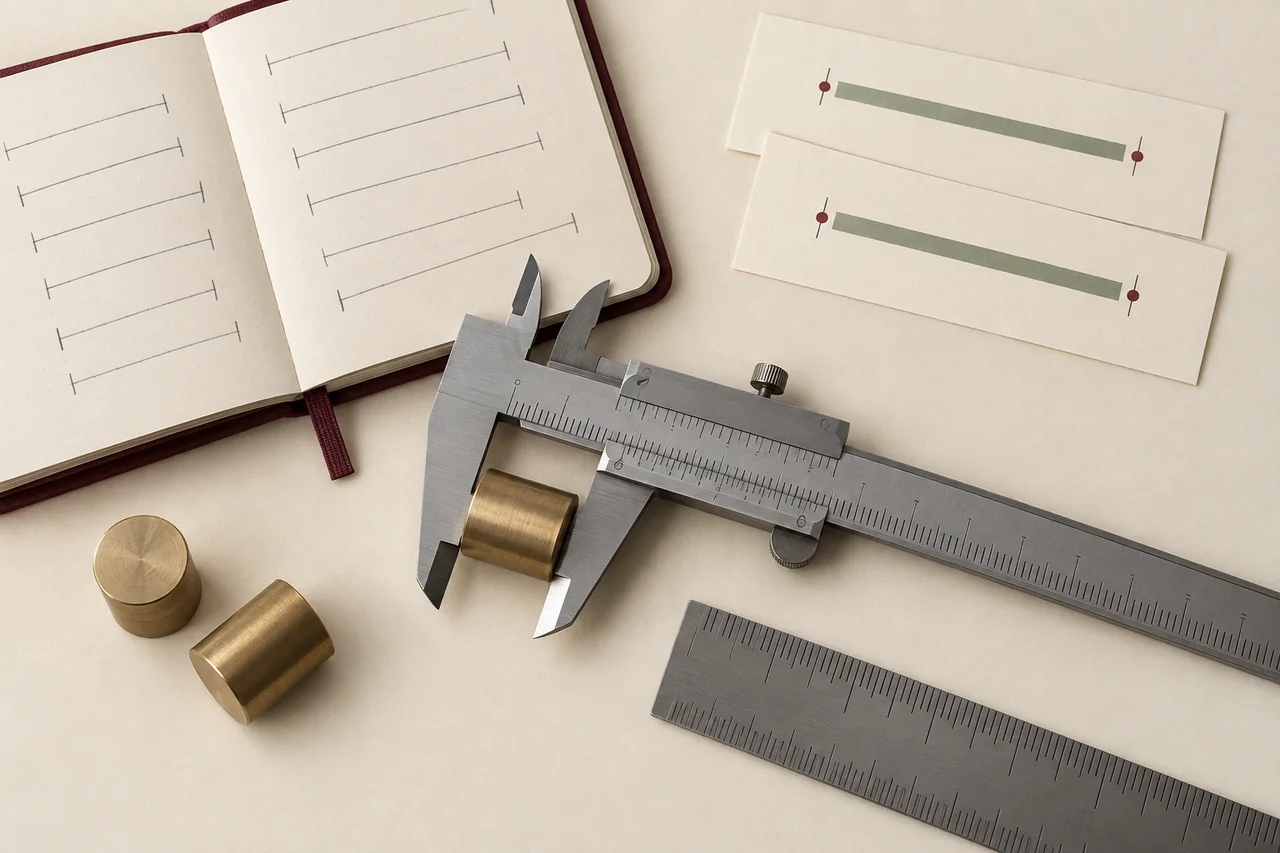
Begin with the raw measurements behind your result. A titration volume comes from a difference between readings; a mass change comes from two masses; a concentration may depend on several quantities. List the instrument, unit, reading method and relevant uncertainty information beside each raw value. Follow your teacher's conventions for the apparatus and calculation involved.
Do not assign the same uncertainty to every measurement because the table looks tidier. Instrument resolution, calibration information and variation between repeated observations describe different aspects of uncertainty.
Distinguish variability from a possible bias
Repeated measurements help you inspect variability, but they do not automatically expose every systematic effect. A consistently miscalibrated balance may give closely grouped readings. An endpoint judged differently by different observers may create another pattern. Explain what your actual records suggest instead of labelling all discrepancy as random error.
Keep qualitative observations with the data. A slow endpoint change, drifting sensor or inconsistent preparation can help you explain why scatter appeared and which part of the method needs attention.
Show one propagation calculation clearly
As an illustrative classroom calculation, suppose each burette reading is assigned an uncertainty of ±0.05 mL. Under a conservative addition convention for the difference, the delivered volume has an uncertainty of ±0.10 mL. For 24.60 mL, this corresponds to approximately 0.41 percent relative uncertainty. State the convention used; other justified uncertainty models may combine information differently.
This example shows why the uncertainty of a delivered volume is not simply copied from one reading. Use the instrument information and approach agreed for your actual investigation.
Compare contributions before proposing an improvement
Express suitable contributions on a common relative basis when the calculation requires it. An illustrative 0.80 g measurement with ±0.01 g uncertainty has 1.25 percent relative uncertainty. Measuring a larger quantity with the same absolute uncertainty can reduce the relative contribution, provided the method and apparatus remain appropriate.
Identify the largest meaningful contribution and check whether changing it would improve the final result. Buying a more precise instrument may have little value if sample variation or endpoint judgment dominates. A proposed improvement should address the limitation established by your measurements.
Carry precision through the calculation
Retain enough precision in intermediate working to avoid rounding away useful information. Present the final value and uncertainty consistently, with units and suitable decimal places under your class convention. Explain calculations so another reader can see how raw values produced the reported quantity.
- Record instrument information when measurements are collected.
- Apply the chosen uncertainty method consistently.
- Include uncertainty in relevant processed results and graphs.
- Avoid interpreting small differences as decisive when the evidence does not support them.
Use uncertainty to qualify the conclusion
Compare your finding with an appropriate reference or model while considering the uncertainty and method limitations. A discrepancy may require discussion of sample composition, assumptions or a possible bias, rather than simply more repeated trials. Explain which improvement would reduce the uncertainty or strengthen the interpretation, how it would work and whether it is practical with school resources. Keep that reasoning connected to your research question.
Your next-step checklist
Checklist choices stay in this browser.
Official references
This is an original practical guide from IBvia. The examples are illustrative; your subject guide, assessment year and school instructions determine the requirements.
Keep working on your next step
Design a science IA you can actually carry out
Move from a research question to a safe pilot, usable data and a specific evaluation of your method.
Read the guide ↗
Eight starting questions for a Biology investigation
Original investigation seeds with measurable outcomes, manageable boundaries and practical checks before collecting data.
Read the guide ↗