Shape a useful Mathematics AA exploration question
Turn an interest into a focused question with a clear quantity, mathematical method and manageable test.
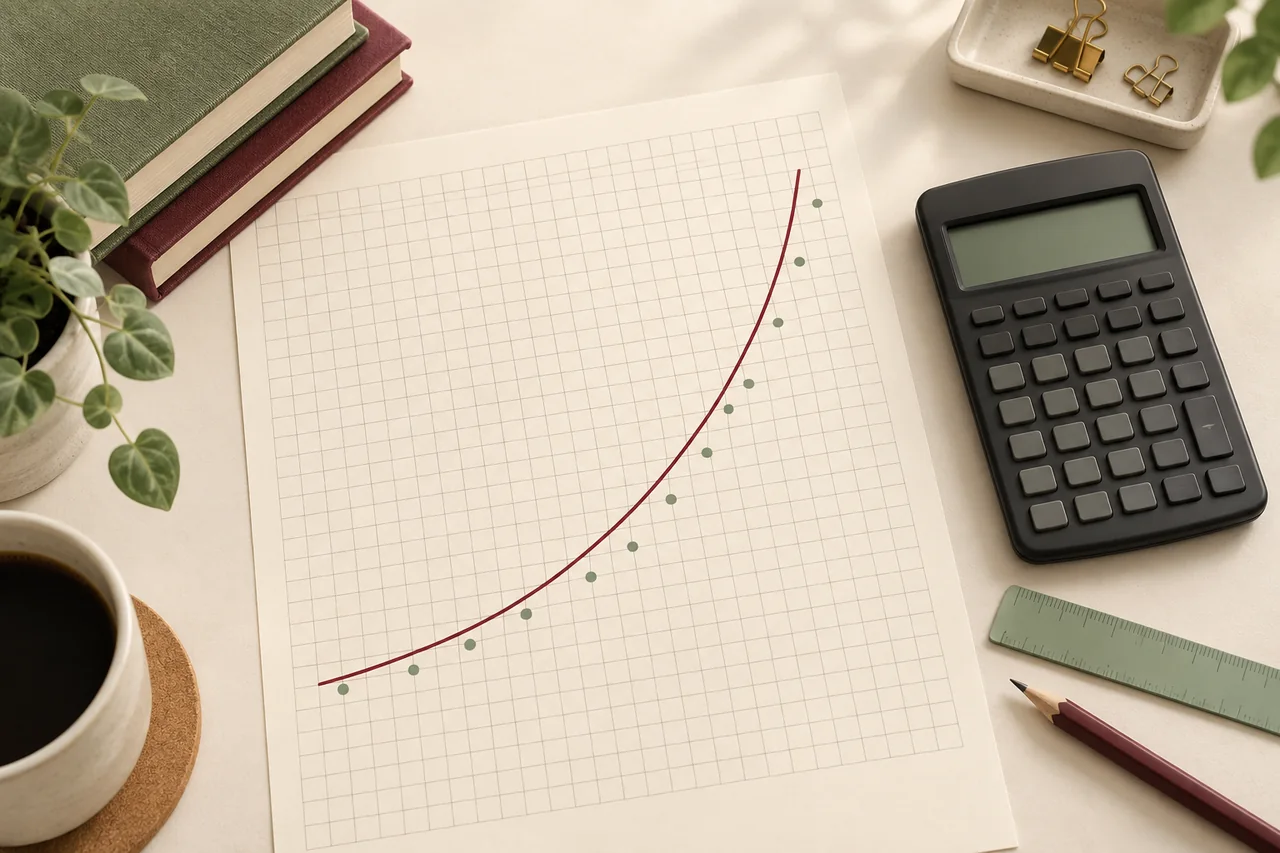
Start with a mathematical decision
An interest becomes workable when you can name what you want to calculate, compare, explain or optimize. 'The mathematics of packaging' covers too much ground. 'Which dimensions minimize the surface area of an open cylindrical container with a fixed volume?' gives you an objective, variables and constraints. The example is illustrative; choose a question whose reasoning you can understand and develop yourself.
Before committing, explain in ordinary language what a successful answer would look like. If you cannot identify that result, refine the question before collecting more material.
Define the scope and assumptions
Write a short model specification. Identify the variable you control, the quantity you want to investigate and the conditions that limit the answer. For the container example, state the volume, units, open top and idealized shape. Decide whether material thickness, joins and manufacturing constraints are initially ignored. These choices determine what your result can mean.
Avoid adding assumptions only after a result becomes inconvenient. Keep a dated list as the model develops so you can explain why a simplification was useful and what it leaves unresolved.
Test the mathematics on a small case
For an ideal open cylinder, V = pi r²h and A = pi r² + 2pi rh. Substituting h = V/(pi r²) gives A(r) = pi r² + 2V/r for r > 0. Differentiation gives A'(r) = 2pi r - 2V/r². A stationary value therefore satisfies r³ = V/pi. You would still need to justify that the value is a minimum and interpret the dimensions.
This short calculation is a feasibility test, not a complete exploration. It shows that the question has an accessible mathematical route and creates a result you can challenge.
Give the result something to compete with
A useful next step is to test how a practical constraint changes the ideal solution. Perhaps the available sheet limits the container's height, or material for the base costs more than material for the side. State the new condition precisely, adapt the objective function and compare outcomes. Choose an extension because it answers your question more accurately, rather than because it introduces a sophisticated-looking technique.
For another topic, the equivalent step might compare a theoretical prediction with measured data or test whether the conclusion holds over a different domain.
Check that the question can sustain explanation
An exploration needs room for your reasoning, choices and interpretation. Ask whether you can explain each technique, show meaningful working and discuss the answer in its original context. Software can help with graphs and calculations, but retain the inputs, units and enough explanation for a reader to follow what the output represents.
- Can I define the variables without ambiguity?
- Can I carry out and explain a small pilot calculation?
- Is there a meaningful limitation or refinement to investigate?
- Can my teacher confirm that the mathematics suits my course and level?
Bring a concrete proposal to your teacher
Prepare the provisional question, model assumptions, pilot calculation and next two actions. Include any sources used for methods or background. A compact proposal makes feedback more specific: your teacher can identify an inaccessible method, an overbroad scope or a missing mathematical link. Revise the question after that discussion and keep the reasoning that led to the change.
Your next-step checklist
Checklist choices stay in this browser.
Official references
This is an original practical guide from IBvia. The examples are illustrative; your subject guide, assessment year and school instructions determine the requirements.
Keep working on your next step
Plan a Mathematics AI regression investigation
Build a defensible dataset, inspect residuals and interpret a fitted relationship without overstating it.
Read the guide ↗
Organize a Mathematics AA exploration around your reasoning
Build a readable exploration in which each calculation, graph and reflection helps answer the question.
Read the guide ↗